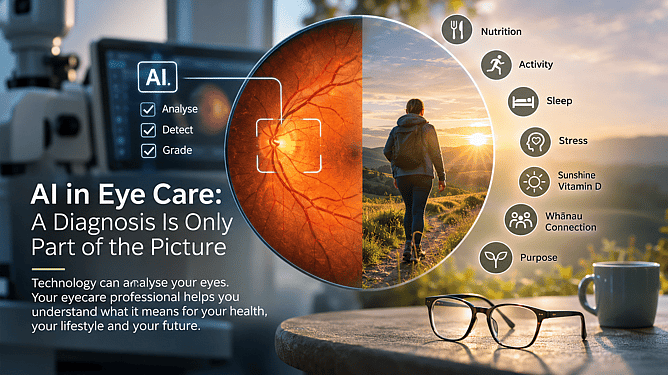
A normal result doesn't necessarily mean you're healthy.
Artificial intelligence (AI) is rapidly becoming part of healthcare. In optometry, it can analyse retinal photographs, identify abnormalities in OCT scans and recognise patterns associated with eye disease.
These are valuable developments. But identifying disease is only one part of healthcare. Understanding what that disease means for the person sitting in front of us, and what they can do about it, is another.
A normal result doesn't necessarily mean you're healthy.
What can your eyes tell us about your wider health?
Consider someone living with type 2 diabetes.
A retinal photograph can identify visible damage to the small blood vessels at the back of the eye. AI can now assess these photographs and help identify diabetic retinopathy.
In New Zealand, someone with no diabetic retinopathy, consistently controlled HbA1c at or below 64 mmol/mol and no additional clinical risk factors may be recalled for diabetic retinal screening in three years. Those with higher HbA1c, retinal changes or other risk factors may require screening at two years or considerably sooner.
These are intervals for checking diabetic retinal changes, not for reviewing or managing diabetes itself.
But imagine receiving a normal retinal result and being told you don't need another photograph for three years.
What does that mean to you?
It means no diabetic retinopathy was detected. It doesn't mean your diabetes has disappeared or that your heart, kidneys and other blood vessels aren't at risk.
The absence of visible damage is not the absence of disease.
And without a conversation explaining that distinction, an opportunity to improve someone's future health may be lost.
The difference understanding can make
When I practised in Tokoroa and Taupō, I noticed a striking difference in how patients understood their diabetes.
Those who had been receiving intervention-focused care from Dr Glen Davies often knew their HbA1c, understood what it represented and could discuss how their lifestyle influenced their metabolic health.
Others had lived with diabetes for years but didn't know what HbA1c was.
HbA1c is a blood test that reflects average blood glucose levels over approximately three months. It helps us understand how diabetes is being managed and the risk of future complications.
For someone who doesn't understand their result, it's simply another number.
For someone who does, it can become a tool for taking greater control of their health.
Dr Davies' work in Taupō reflects an approach also demonstrated internationally.
In the UK, GP Dr David Unwin and psychologist Dr Jen Unwin have spent years helping people with type 2 diabetes understand how nutrition, particularly carbohydrate intake, and behavioural changes can improve metabolic health.
In their published eight-year programme, 51% of participating patients achieved remission of type 2 diabetes.
In the United States, Virta Health has combined nutritional support, remote monitoring, medical oversight and ongoing health coaching to help people improve blood glucose control, reduce medication requirements and, in some cases, achieve remission.
These programmes differ, but they share an important principle.
Giving someone information is not the same as helping them understand it, act on it and sustain that change.
Why does this matter during an eye examination?
Type 2 diabetes is closely associated with insulin resistance, where the body's cells become less responsive to insulin.
Nutrition, physical activity, sleep, stress and weight management can all influence metabolic health. For some people, sustained lifestyle changes alongside appropriate medical care can significantly improve blood glucose control and even lead to diabetes remission.
An eye examination provides an opportunity to connect these factors with what we see in the retina.
We can explain why elevated blood glucose and blood pressure can damage the delicate retinal blood vessels, how these same conditions affect the kidneys and cardiovascular system, and what actions may help reduce future risk.
But that conversation also needs to consider the person.
Someone working long shifts, raising a family or managing financial pressures may face very different challenges in making lifestyle changes from someone with greater time and resources.
In Aotearoa New Zealand, the concept of Hauora recognises that our health extends beyond physical wellbeing to include our mental and emotional wellbeing, our whānau, our social connections and our sense of purpose.
These factors influence our health, our choices and our ability to make lasting changes.
The goal isn't for your optometrist to replace your GP or diabetes team. It's to reinforce the connection between your eyes and your wider health, while understanding the circumstances that influence your ability to look after both.
Because preventing damage is considerably better than discovering it once it has occurred.
Where AI can genuinely improve your care
AI isn't limited to analysing photographs and scans.
One development I'm particularly interested in is the use of AI clinical scribes.
Traditionally, healthcare professionals spend considerable time typing notes, recording findings and preparing letters. AI scribes can help document consultations, allowing the clinician to spend more time looking at and talking with the patient rather than concentrating on a computer screen.
With the patient's knowledge and consent, these systems can help produce clinical notes and correspondence that the healthcare professional checks before they become part of the medical record.
This has potential benefits beyond saving time.
Imagine your optometrist identifying changes that may relate to your diabetes, blood pressure or another health condition. A clear, timely report to your GP can help connect that finding with your wider medical care.
As healthcare systems become better connected, AI may also help bring together information from medical records, previous eye examinations, blood tests and even wearable devices such as continuous glucose monitors.
Over time, this could help clinicians develop a more personalised understanding of an individual's health risks, rather than interpreting each test in isolation.
We're still in the early stages. The accuracy, privacy and security of that information matter, and clinical decisions must remain appropriately supervised.
But this is where I see genuine opportunity: using technology to improve communication, continuity and the quality of the time we spend with patients.
The future of eye care
AI will continue to improve how we detect and monitor eye disease. It may make some tasks faster, reduce administrative workloads and help healthcare professionals communicate more effectively.
We should embrace those improvements where they genuinely benefit patients.
But faster diagnosis doesn't automatically mean better healthcare.
A retinal photograph cannot tell us whether someone understands their diabetes, is struggling to manage their medication, has difficulty accessing healthcare or is worried about losing their independence.
Nor can a test result alone tell us what matters most to that person.
The real measure of progress should be whether people understand their conditions, receive appropriate treatment, feel supported in making changes and experience better long-term health.
At Ashburton Eyecare, we believe good eye care involves more than measuring how well you can see or examining the structures of your eyes.
It's about understanding the person behind those eyes.
Because the goal isn't simply to identify disease or damage. It's to help people understand their health and prevent as much of that damage as possible.

